
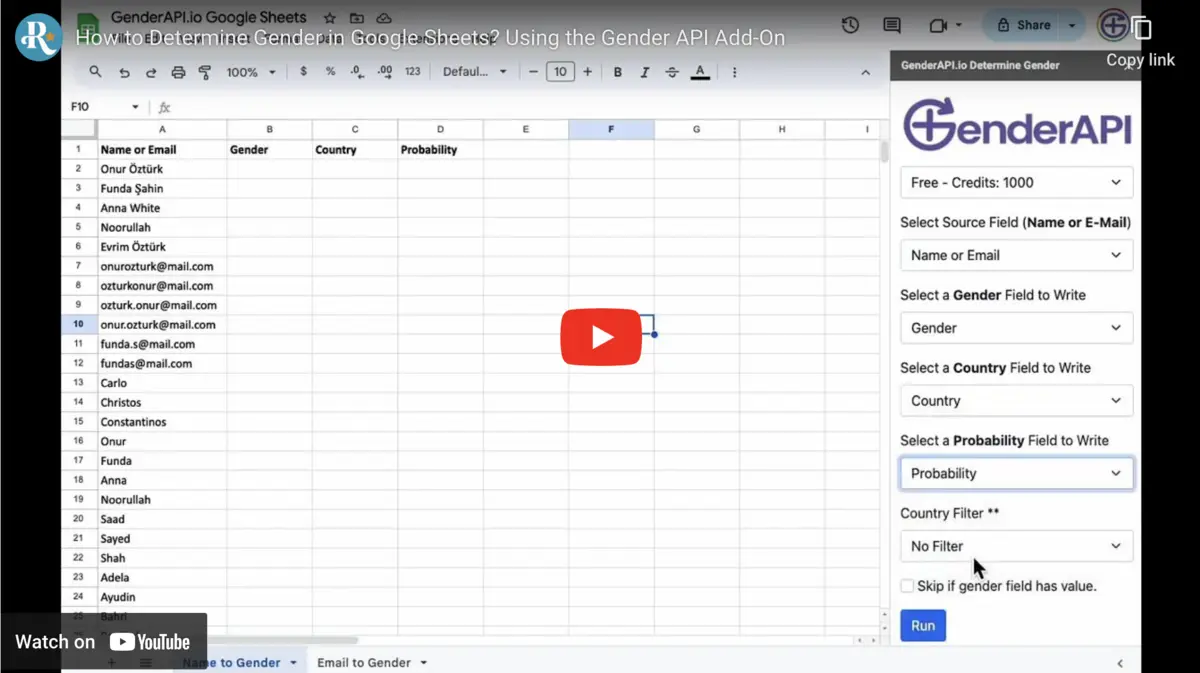
Use the sidebar for a controlled batch of rows
The GenderAPI Google Sheets add-on reads a name, email or username column and writes selected result fields into your sheet. The sidebar is useful when you want to choose a row range and store the resulting values without maintaining a formula in every cell.
This is the native add-on workflow. Its existing result columns and job processing are separate from the public REST V2 response format.
Install, connect and run a small sample
- Install the add-on from its Google Workspace Marketplace listing and review the requested permissions. In Sheets, open Extensions, choose GenderAPI and open Determine Gender.
- Select your GenderAPI key or enter it in the sidebar. Confirm that the selected account has available credits.
- Choose the worksheet and the input method: name, email or username. Select the matching source column and a small row range that excludes headers.
- Choose a separate gender output column and any optional probability, country and found-name columns. Avoid overwriting your source values.
- If you have reliable country context, use the available country setting or a country-code column. Do not infer context from the prediction you are about to request.
- Review the skip-existing-results option, start the job and inspect the selected rows before expanding the range.
Map the inputs and destinations
| Setting | Type | What to choose |
|---|---|---|
| API key | Account credential | Use the key selected in the add-on; confirm balance and validity. |
| Method | Choice | Name, email or username, matching the source column. |
| Worksheet and row range | Sheet plus row numbers | Choose only the rows to process and omit your heading row. |
| Source column | Column reference | The single input column for the selected method. |
| Country context | Optional setting or column | Use reliable two-letter country codes when available. |
| Result columns | Column references | Gender is the primary destination; probability, country and found name are optional. |
| Skip existing output | Checkbox | Review the current setting so a rerun does not unintentionally replace completed rows. |
Read the native result columns
Keep your original input beside the result. A name-based association does not establish a person's self-declared gender, and a returned country is not verified residence or nationality.
- Inspect an ordinary result, an ambiguous input and a failed operation before processing a full dataset.
- A blank cell, the text null and a formula error are different spreadsheet values. Normalize unknown results deliberately without hiding errors.
- Use a neutral fallback for unknown or uncertain records. Keep supplied profile information separate from inferred columns.
| Output | Typical type | How to use it |
|---|---|---|
| Gender | Text or unresolved value | Retain male or female only for a successful result. Preserve an unresolved value as unknown; review error text separately. |
| Probability | Number, when available | A legacy confidence signal. It is not the V2 confidence field or a measured accuracy rate for your dataset. |
| Country | Text, when available | Context returned by the lookup. Keep it separate from a customer's verified country. |
| Found or normalized name | Text, when available | The name used or extracted during processing. Review it for ambiguous emails and usernames. |
Plan for credits, limits and repeated runs
A registered free GenderAPI account includes 200 credits per day. Credits are an account balance, not a promise of 200 successful results in every workflow. Check the selected key's balance and the tool's current processing options before starting.
Native add-ons and file jobs have their own processing paths. The REST V2 batch limit, AI options and per-request billing fields do not automatically apply to them. A repeated run or recalculation can submit fresh work; do not assume it is free.
Start with a small sample, retain completed results, and review the failed rows before rerunning. If you only need to repair a later export or destination update, reuse the results you already have.
Choose the data you share
The spreadsheet integrations transmit values needed for lookups and require permission to work with the selected document. Review access to the workbook, the connected account and the destination columns before processing personal data.
Keep API keys in the add-on's settings rather than ordinary cells, screenshots or shared examples. The published privacy policy describes input handling, retention and logs; spreadsheet integration does not mean that data remains entirely on your device.
When to use the direct V2 API
Use a separate HTTP integration when your application needs explicit AI options, per-item status, source, confidence kind and usage information from V2. Follow the V2 request and response contract; adding V2 field names to a native formula or existing add-on does not change that client's behavior.
Frequently asked questions
Do I need to write code to use the sidebar?
No. Install the add-on, connect a key and map the source and result columns. A direct V2 API integration is a separate option for custom applications.
Can I process existing rows?
Yes. Use the sidebar's worksheet and row-range controls. Check headers, input type, destination columns and existing-output settings before starting.
Are the result columns the V2 JSON response?
No. The native job writes its supported spreadsheet fields. V2 data, meta, source and confidence_kind belong to the direct REST API contract.
What should I do with an unknown result?
Keep it unknown and distinguish it from a failed operation. Review ambiguous inputs and use a neutral fallback rather than assigning a gender automatically.
Reference sources
This guide and its reference sources were reviewed on . Use the platform references for setup details and the linked API documentation for a separate V2 integration.